Programme Leader

25th of May 2019

I signed up for this level after receiving my result from assessment at level two. I was informed that I would have a chat with the programme leader and they could help me move forward onto level three. 

I went into the chat with a few ideas, projects that I have done before and would like to develop and create a body of work. One idea that I was tending towards was pilgrimage, as a journey. I did this in my Landscape course for assignment Two, and I really enjoyed it as it allowed my to bring knowledge from my previous studies in religion. This was merely documenting a journey, as the brief require. But I hadn’t really considered how to take it further. In the discussion we discussed this, as the programme leader thought this would be an interesting project. We talked about any research I had done, and it became apparent that the practitioners, artists and researchers were men. This is also true about a lot of pilgrimages, especially around where I live, as they were only for men. This brought forward an idea of using this as the main body but explore the gender inequality. Landscape photography is a male dominated practice, it seems to be tradition now, I believe my idea will challenge this thought. I will look at feminism, the female sublime and gaze, and the gender inequality whilst using a male dominated background. 

We also discussed previous issue and how these can improve, One was with reference. There was some confusion in my previous course, the programme leader understood this and provided a new comprehensive guide to referencing, which proved to be much clearer and simpler. The programme leader also helped choose the tutors who would be the most helpful and knowledgable regarding my idea. The two that the programme leader has chosen, I am sure with be supportive and helpful in my work. 

Initial Discussions

Programme Leader

25th of May 2019

I signed up for this level after receiving my result from assessment at level two. I was informed that I would have a chat with the programme leader and they could help me move forward onto level three. 

I went into the chat with a few ideas, projects that I have done before and would like to develop and create a body of work. One idea that I was tending towards was pilgrimage, as a journey. I did this in my Landscape course for assignment Two, and I really enjoyed it as it allowed my to bring knowledge from my previous studies in religion. This was merely documenting a journey, as the brief require. But I hadn’t really considered how to take it further. In the discussion we discussed this, as the programme leader thought this would be an interesting project. We talked about any research I had done, and it became apparent that the practitioners, artists and researchers were men. This is also true about a lot of pilgrimages, especially around where I live, as they were only for men. This brought forward an idea of using this as the main body but explore the gender inequality. Landscape photography is a male dominated practice, it seems to be tradition now, I believe my idea will challenge this thought. I will look at feminism, the female sublime and gaze, and the gender inequality whilst using a male dominated background. 

We also discussed previous issue and how these can improve, One was with reference. There was some confusion in my previous course, the programme leader understood this and provided a new comprehensive guide to referencing, which proved to be much clearer and simpler. The programme leader also helped choose the tutors who would be the most helpful and knowledgable regarding my idea. The two that the programme leader has chosen, I am sure with be supportive and helpful in my work. 

Contextual Studies

1st of June 2019

I have just had the initial discussion with my tutor, which has proved extremely helpful. We discussed my aims, which my tutor think will be very interesting. She helped me with the referencing issue, and provide a much clearer guide. I was asked to work out some submission dates, which I have done and will email over soon. 

Part One – Visual Culture in Practice

Modernism – The Photograph Itself

24th of June 2019

Read Walter Benjamin’s essay ‘The Work of Art in the Age of Mechanical Reproduction’ in Evans & Hall (1999) Visual Culture: The Reader (also available online). 

What do you think about Benjamin’s Viewpoint? And Kracauer’s?


Modernism paved the way for  complete change in many aspects, like in literature, architecture, and in art. It is not based on one characteristic but covers a range of contributing ideas. Following the Second World War, there become a universal need for ‘healing’. People believed this could be achieve by a new outlook, this manifested in at first a change to the design of basic items like clothing. It induced a utopian feeling. This then moved into the art world. One aspect of modernism is nihilism, which rejects moral and religious doctrines. So basically a completely new tradition that anything before. Artists would experiment with new materials and techniques, in an aim to explore form. Modernism promoted a new world view, one which was simple and uncomplicated, the perfect world, a utopia. 

Benjamin starts by stating that “a work of art has always been reproducible” (Benjamin, p. 72). This is true, nowadays it is common to see images of a piece of art everywhere from a book, to on the television, and especially on the internet. Images tend to be copied to share around the world, even images of cave paintings are widespread, but art in the form of artefacts or idols are slightly more difficult to replicate. Reproduction has always gone on, but it has taken different forms. Painters would practice by copying their mentors work. Over time, it has taken forms in engravings to lithographs to printing and now photography. By the twentieth century, it has been possible to reproduce all available pieces of art. This method itself has also managed to have a hold in the artist’s process. 

According to Benjamin, these reproductions have one main fault. They lack presence. They can not replicate the originals authenticity and presence. “The technique of reproduction detaches the reproduced object from the domain of tradition” (Benjamin, p. 74). Perception has also changed over time. For example in the art from the fifth century was very different from art that came before, this was brought about by a different type of perception. Traditions changed. These traditions aid in the artworks ability to be unique. 

At the beginning art tended to be for ritual purposes. These took two forms, the first being magic, the second being religion. These roots can be found in artwork today, they come from a tradition, which hasn’t completely vanished. To successfully analysis art, in light of reproduction, you need to be aware of these traditions. Mechanical reproduction has allowed art to be liberated from its roots. It is not depend anymore. The art is also now destined to be reproduced, it is inevitable. 

The value of art is variable. On one hand is has cult value, on the other is has exhibition value. Today it is more common for art to hold a value for exhibition. Photography is a good example of this. This is also seen in film. Film is able to produce two representations, one in how the person is presented and second, how, due to the mechanical equipment, the person can embody the environment. Photography can show what we cannot see. 

Benjamin believes art has an aura, which is linked to its ritual purpose. But this aura is diminished the more it is reproduced mechanically and the more it is looked at out of context. As I said earlier, our perception changes, our culture and social changes also alter our perception, this is why the exhibition value holds more stead. The exhibition value over time becomes more important that the artworks aura. Whilst by mechanical reproduction, art can be reproduced, these reproductions lack the authenticity of the original, it lacks the presence of the original, but it also has created something new. The more a piece is reproduced, the more it’s aura is chipped away. Photography does not have the same aura that is able to be diminished. 

Not everyone agrees with Benjamin’s view. Some believe that mechanical reproduction strengthens the aura by preserving it, for example Mary Warner Marian I one who holds this belief. I agree with Benjamin that the more reproductions that are made, causes a decreases in the artworks presence. It places a different value on these reproductions. But I do not think that is does distract from the original. We all know that the reproductions are just that, they are copies of the original, whilst they do not process the originals authenticity, they give us a chance to see it p, they are available worldwide to all, but they do not have the wow factor that the original has. There is a different feel from seeing an original to seeing a copy. The problem is that if you see a copy of the original, are you going to go and see the original, for the majority, the answer is probably no. So it does have an effect on the originals, but in today mechanical reproductions are so common, we see them all the time but we don’t really take much notice. 

Siegfried Kracauer believes that the more we become familiar with an object, over time it loses its authenticity and originality. He makes a point that memory can be effected by things like camera, which capture a scene. I believe he has a point, whilst photographs have the ability to trigger a memory, they also do not promote us remembering the exact event, as people’s recollection varies. Often photographs are becoming our memories, we do not need to remember because we have it on film (Kracauer. p. 58). Sigmund Freud commented on memory and issues that surround it. He cited two types of memories, natural and artificial. A photograph would count as artificial memory. In his essay, ‘Civilization and its Discontents’, he states, “In the photographic camera he has created an instrument which retains the fleeting visual impressions, just as a gramophone disc retains the equally fleeting auditory ones; both are at bottom materializations of the power he possessed of recollection, his memory” (Freud (1930), cited in Bate (2010). This is similar to the point Benjamin made about the camera capturing the unseen things. Freud’s essay was published in 1930, whereas Benjamin’s was published in 1931, so only a year apart. Photographs can aid in memory and at the same time contribute to its destruction. 


Bibliography

Bate, D. (2010) ‘The Memory of Photography’ In: Taylor & Francis Online. 6th of September 2010. [Online]. At: https://www.tandfonline.com/doi/full/10.1080/17540763.2010.499609 (Accessed on 17th June 2019). 

Benjamin, W. (2007) ‘The work of art in the age of mechanical reproduction’ In: Evans & Hall (ed.) Visual Culture: A Reader. London: Sage Publications Ltd. pp. 72-79. 

Kracauer, S. (1995) The Mass Ornament: Weimar Essays. London: Harvard University Press. p. 58. 

Marien, M. W. (2006). Photography: A Cultural History (2nd edn). London: Laurence King Publishing Ltd. pp. 302. 

MDC. History of Modernism. At: https://www.mdc.edu/wolf son/Academic/ArtsLetters/art_philosophy/Humanities/history_of_modernism.htm (Accessed on 19th of June 2019). 

Tate. Art Term – Modernism. At: https://www.tate.org.uk/art/art-terms/m/modernism (Accessed on: 19th of June 2019). 

V&A. What was Modernism? At: https://www.vam.ac.uk/articles/what-was-Modernism (Accessed on 19th of June 2019). 

V&A. What is Postmodernism? At: https://www.vam.ac.uk/articles/what-is-postmodernism (Accessed on 19th of June 2019). 


Postmodernism – What surrounds the photography

25th of June 2019

Read Douglas Crimp’s essay ‘The Photographic Activity of Postmodern controversialism’ on the OCA-Student Website. This essay was first published in October 15 (Winter 1980) and is also available in Crimp, D (1993) On the Museum’s Ruins. Massachusetts: MIT Press. As with all the readings you’ll be asked to do for this course, make notes on what you‘ s read – and it’s relevance to your practice (if any) – in your research folder. See also: www.afterwalkerevans.com/ and www.aftersherrielevine.com/ 


Postmodernism is a controversial movement, which is hard to pin point a definition. It spanned around two decades from the 1970s up until the 1990s. Similar to Modernism, it changed art completely, but in this instance it was a force against the modest ideals. ‘Anything goes’ is a saying that comes to mind with postmodernism, there was a complete mix of ideas. One characteristic was the bringing together of ‘cultural hybrids’, this created unique artworks. If Modernism is a utopia, postmodernism is a dystopia. Postmodernism become the norm for consumerism, this was its downfall. 

Postmodernism is a rift that has emerged from modernism. According to Douglas Crimp, “Photography had overturned the judgement – seat of art is a fact that modernism found it necessary to repress, and so it seems that we may accurately say that postmodernism constitutes a return of the repressed” (Crimp, p. 108). Postmodernism is about ‘plurality’, it is diverse. It is about plurality but not pluralism. Pluralism is a fantasy, it promotes the thought that art has been liberated. Crimp wants to discuss ‘plurality of copies’. 

During the 1970s postmodernism took one form in performance art. It was made for the viewers not for the artist. It was the ‘suggested aesthetic mode’. Crimp wanted to explore the shift from the presence, similar to that in performance art, to the presence that is achieved by absence. Which becomes representation. The author, Henry James, is able to use this latter, in his ghost stories. Even though the ghost is there, but it is actually an absence. So it is present and absent at the same time. This presence by absence can be achieved by representation, by using technology, something can be reproduce so it is present by in itself absent. This can be seen in the Two Fencers by Jack Goldstein and also in Surrender by Robert Longo. The use of holograms created a presence which was lifelike but it was also eerie absent figure. There is a distinction from the original. “Such presence is what I attribute to the kind of photographic activity I call postmodernist” (Crimp, p. 111). Crimps view is different from Walter Benjamin’s, in the sense of the quality of the presence. Benjamins aura relates to the presence of the original work. For Benjamin aura is diminished when more copies are made. Benjamin believes that only particular photographs have aura. Mainly photographs from its discovery, before around 1850. The aura comes from firstly the exposure times and secondly the subject. Aura is not really effected by the photographers presence but rather in the subject being present. 

Many have tried to get aura back. This has been tried using two forms, the first in expressionist paintings and the second in photography being recognised as art. But Crimp states that what is needed is a Connoisseur. Photographs don’t always get into museums. A connoisseur can authenticate a photograph. “The photographic activity of postmodernism operates, as we might expect, in complicity with these modes of photography-as-art, but it does so only in order to subvert or exceed them” (Crimp, p. 117). This is related to aura, but it doesn’t bring it back, it changes it. Mass-advertising has effected our culture by manipulation. It is able to disguise its direction. “In our time, the aura has become only a presence, which is to say, a ghost” (Crimp, p. 124). 


Bibliography

Crimp, D. (19993) On The Museum’s Ruins. Massachusetts: MIT Press, p. 108-124.

Irvine, M. Approaches to Po-Mo. At: faculty.georgetown.edu/Irvine/theory/Pomo.hmtl (Accessed on 19th of June 2019). 

Tate. Art Term – Postmodernism. At: https://www.tate.org.uk/art/art-terms/p/postmodernism (Accessed on 19th of June 2019). 

V&A. What is Postmodernism? At: https://www.vam.ac.uk/articles/what-is-Postmoderism (Accessed on 19th of June 2019). 


Poststructuralism – and the language of photography

26th of June 2019

Read ‘The Rhetoric of the Image’ by Roland Barthes in your course reader. If you want to take your study of semiotics further you could so worse than reading Daniel Chandler’s book Semiotics: The Basics or look at the web version at: www.aber.ac.uk/media/Documents/S4B/semiotic.htm/


The poststructuralism movement came in response to the structuralism movement, it arose in the 1960s in France, it started as a movement in philosophy and literature. It began emerging in other art forms over time. It came together using the deconstructional ideas of Jacques Derrida, anthropological theories of Creuda Levi-Strauss, and the linguists from Ferdinand de Saussure. It declares that a code of principles, will allude to a meaning, they act together without any input from a world outside. 

Barthes started by discussing the origins of the word ‘image’, which is from imitari, meaning to imitate. According to Barthes, an image will contain three messages. He uses a Panzani advert to illustrate this. The first message takes its form as linguistic. This is basically the text that supports the image. This message takes two forms, connotational and denotational. Often what is signified can depend on the viewers interpretation and our culture. The second message is iconic. Which is to do with the signifiers, mainly what is photographed. The third message is to do with the relationship between the signifiers and what is signified. So the three messages are linguistically, a coded iconic and non-coded iconic message. 

Text is an aid in deciphering an image. Sometimes it describes the scene, other time it elaborates it further, it is a form of direction, it leads the viewer to discover the signified parts of the image. But the text holds control over the image, this is its anchorage. This is found in main types of images, in particular in adverts. Relay is found more commonly in comic strips. These two functions are capable of working side by side.  According to Barthes, it is a “matter of a denoted description of the image” (Barthes, p. 37). This relates to the anchorage of the many meanings. When looking at the symbolic message, this restricts the connoted meaning, it is down to interpretation now. Barthes believes it is impossible to find an Images literal message in its pure state. Photographs appear to be a ‘message without a code’. On the other hand, drawings are coded. They have three levels, to replicate a scene using ruled transpositions, the coding requires the differentiation between the insignificant and significant, and lastly they need an apprenticeship. But in photographs, the transformation part, isn’t that, it become a recording function. It promotes the idea of realism, one which is taken mechanically. Our input into taking a picture, for example the lighting, the focus, the speed is the connotation, which comes from a cultural code. “Only the opposition of the cultural code and the natural non-code can, it seems, account for the specific character of the photograph and allow the assessment of the anthropological revolution it represents in man’s history” (Barthes, p. 40). The denoted images therefore, does not hint at a code, but plays an important role in the structure of the iconic message. 


Bibliography

Barthes, R. (2007). ‘Rhetoric of the Image’ In: Evans & Hall (ed.) Visual Culture:A Reader. London: Sage Publications Ltd. pp. 33-40. 

Encyclopaedia Britannica. ‘Poststructuralism’. [Online]. At: https://www.britannica.com/art/poststructalism (Accessed on 19th of June 2019). 


Photography and Reality

27th of June 2019

Read ‘Photography’ (Chapter 2) in Howells, R. (2011) Visual Culture on the OCA-Student website. Note down your own response to Howell’s arguments. 


The relationship between reality and photography is a complex one. It is difficult, in the arts, to depict reality. Technically, with photography it is a given. Howells takes us through history, starting with prehistoric paintings. But photographs history is only over 150 years old. The first photography is dated back to 1827. It was known as painting with light. It has taken centuries for the techniques to come together, you need both chemistry and physics. Physics allows the creation of the image, whereas chemistry allows us to preserve said image. The physics side was born with the camera obscura. This technique has been around since the tenth century, where a dark room would have a small hole that allowed light in, this would allow images to be depicted on the wall. But they were upside down. When a lease was added to this method, the images righted themselves, this happened during the Renaissance. This then developed into a box instead of a room. But none of these images were permanent. But due to chemistry advancement during the eighteenth century, Johann Heinrich Schulze found that some chemicals were photosensitive, namely certain types of silver. A few tried to make the images permanent, some failed, but Joseph Nicephore Niepce succeeded. Niepce then worked with Louis Jacques Mande Daguerre, together they made a quicker easier method to preserving an image. They became extremely popular. This technique produced an image of reality, they could not be copied either, so where unique. William Henry Fox Talbot used paper which was sensitised with silver chloride, he would place objects on the paper, these become the first contact prints. Talbot also developed the positive and negatives. This paved the way for being able to produce copies. By placing a negative image on another paper, another print could be fixed. This allowed unlimited positives to be made from one negative. It wasn’t until 1888 when Kodak created a camera that would be available to the general public. Leica went on to release their 35mm in 1925. Colour images were developed in 1935 by Kodak. But it wasn’t until 1994 when Kodak created the first digital camera, which was available to the public from 1996. 

Photography were used to document reality. War photographers could document the wars, other things like social change began being recorded. Photographs “had an authenticity that fine art could never accomplished” (Sekula, p. 190). Sekula states that as the camera is a mechanical recording device, it is only possible to show what is real. This is also a reason for why photography can not be viewed as art. “The photograph does not create the drama; it just reports it. That cannot be art” (Sekula, p. 191). Roger Scruton believed that if the subject is beautiful then that is where the beauty comes from in a photograph, as against in a painting which can be beautiful regardless of its subject. Sekula argues against this, as the photographer must made choices when creating an image, a beautiful Images does not come from a beautiful subject. “The eventual photograph, then, is the result of creative choices that began at the very setting up of the tripod…A photograph, after all has formal properties that transcend its subject-matter” (Sekula, pp. 193-194). Susan Sontag also comments, “Photographs are as much an interpretation of the world as paintings are” (Sontag, cited in Sekula, pp. 196-198). Andre Bazin does not believe that a photograph shows reality, as the very action of taking an image has liberated that image from ‘time and itself’, so it cannot show reality as it’s time has passed. It instead produced an aspect of reality. 

“Photography is; a meeting of the actual and the imaginary, where each adds to, rather than detracts from, the power of the other” (Sekula, p. 200). Photographs themselves are predetermine to be interpreted ideologically. Sometimes interpreting iconography is overdone. Semiotics are important for analysing as by successfully interpreting an image, you can learn and understand its value. 

Many people have analysed Scruton approach. William King believes there are two chances, based on the reasons we look at a photograph. The first would indicate Scruton is right, when “our reasons for looking at a photograph coincide with our reasons for looking at its subject-matter”, but if “we look at a photograph driven by an interest that does not entirely coincide with our interest in its subject-matter, then Scruton is wrong” (King & Sekula, p. 202). Many see this as a weak view, for example Nigel Warburton. Warburton believes that Scruton is talking about ‘ideal photography’. Warburton looks at ‘individual style’. He believes we should look deeper than what is shown. It is impossible to find the style in one image, you need a series. This involves contextualisation. A style and the artists aim will become evident. “In other words, the photograph can now be seen as a work of art” (Sekula, p. 205). 


Bibliography

Howells, R. (2011) Visual Culture: A Reader. Cambridge: Polity Press, pp. 183-206.


Photography in the Global Age

28th of June 2019

Read Allan Sekula’s essay ‘Reading an Archive: Photography between Labour and Capital’ in Evans & Hall (1999) Visual Culture: The Reader.

Note down your response to this essay – and your thoughts on the discussion of globalisation above. 


Photography is the global age relates to my body of work as one it will be published online for all to view but also I intend to bring a local pilgrimage to a globally available audience. 

Sekula states that his aims to looking into the relationship between economic life and photographic culture. Archives are important, and their forms are numerous. Archives can be personal or public, their ownership varies too. For photography, the owner of the archive and the actual taker of the picture are not usually the same person or institute. “Archives, then, constitute a territory of images; the unity of an archive is first and foremost that imposed by ownership” (Sekula, p. 182). Meaning and context are important to photographs, an Images meaning is formed due to its text, it’s format, and its presentations. These all contribute to a fuller picture. According to Sekula, “photographic archives suspend meaning and use, the archive meaning exists in a state that is both residual and potential” (Sekula, p. 184). Archives can contradict themselves. This can be through science and art. A dualism exists in photography, which has been around from its birth. These archives preserve the relationship between power and knowledge. “Photography is an art. Photography is a science. Photography is both an art and a science” (Sekula, p. 190). 


Bibliography

Sekula, A. (2007). ‘Reading an archive: photography between labour and capital’. In: Evans & Hall (ed.) Visual Culture: A Reader. London: Sage Publications Ltd. pp. 181-192. 


Assignment Five – Final Draft

Brief

Submit a final draft of your extended written project to your tutor, implementing any changes or taking on board any advice given in their feedback on your draft manuscript.

  • Submit a covering note identifying the parts of your extended written project that have been most substantially revised or developed. That way your tutor can focus on your revisions rather than re-reading the whole extended written project.
  • Write an abstract for your extended written project (maximum 500 words) summarising the subject areas discussed in your extended written project and its key findings to conclusions. This will be used to archive your extended written project at OCA, and to identify appropriate assessors with related subject knowledge to formally assess your submission.

Assignment Five

Here is my written project:


Following my tutor tutorial on my first draft of my essay, I have made some changes. I have gone through and addressed the issue my tutor has highlighted. I have taken out the waffly bits of writing and have taken pieces out that were not need. 

I have changed several things throughout my work. I have made minor changes to chapter one. I have re-worked chapter two. I have kept some aspects the same but have added new information. The majority of chapter three is the same to the first draft, but I have done some minor changes here too.  

I have written my abstract which has come in at under 500 words. I did some research into abstracts before writing mine, I wanted to make sure I was writing the correct things in it. I have placed my abstract after my title page. I am not sure whether this is the correct place or whether it needs to be on a completely separate document. 

My written project take the following format:

  • Title Page (Including title and word counts) 
  • Abstract
  • Contents Page
  • Introduction
  • Chapter One
  • Chapter Two
  • Chapter Three
  • Conclusion
  • References
  • Figures
  • Bibliography

I have included the images within the actual text as I felt it was easier to see the images next to the text that is exploring them. 

I believe this format is correct, and looks right. 

My work count has come in at 5384 without the quotes and referencing. It is 9181 in total including the referencing, quotes and bibliography. Without the bibliography it is 5929 words. The abstract is 465 words. 


Rework – Final Draft

I have reached the end of my course and have compiled my final submission for assessment. 

I have edited my extended written project extensively along the way in light of feedback form my tutor, and this is my final submission: 

My work is titled – Gender Inequality in Landscape Photography.

My work features an abstract, a content page, an Introduction, three main chapters, a conclusion, a references list, a figures list and a bibliography. I have noted the word count on the first page of the document alongside the title and any relevant information. 


Tutor Feedback

Here is a link to my tutor’s feedback for this assignment and also my comments and how I am responding to the feedback:

Tutor Feedback


Assessment Criteria

Demonstration of subject based on knowledge and understanding

I believe I have demonstrate my knowledge of my subject. I have researched the topic extensively and have used this research in the formation of my essay. I have brought my knowledge and research together to form my final essay. I have explored various topics within my subject area and have brought these together in a coherent manner and have presented them together in my work. 

Demonstration of research skills

I have done some in-depth research into gender inequality in landscape photography. My research folder in evident for this. I have looked at various primary and secondary sources, in the form of books, journals, research papers, and websites. I have looked at the topic specifically but also looked further a field and have used that knowledge and explained in my work why it is relevant. I believe I had done extensive research for my work. 

Demonstration of critical And evaluation skills

I have presented my ideas and have provided an analysis and an evaluation. I have brought ideas together and analysed them and gave my own reasons. I felt I was critical of what research I would use as I had to analysis each resource and decided what to use and what not to use. I believe my evaluation skills can be seen in my final essay. I have brought my ideas together using my research and have presented complete final essay. 

Communication  

I have written blog post throughout my course, which I believe are clear and explain what I am doing. I believe I have communicated my ideas well. It is something that I have worked on from assignment three and have developed significantly. My tutor has mentioned that my sentences needed changing as they can be too wordy and I need to do a general proof-read, which I have done. I went over my work and changed any sections that didn’t make or could have been said easier. 

Assignment Four – First Draft

Brief

Submit the draft manuscript for your extended written project, observing the following submission guidelines:

  • 5,000 words in length (+/- 10% maximum). This excluded quotations, footnotes, bibliography and direct quotations.
  • Your extended written project must be typed using Microsoft Word or similar word processing software. Don’t use design software such as Adobe InDesign. It should be A4, portrait orientation, set at 12pt in a plain typeface, at 1.5 line spacing.
  • Your extended written project must be fully illustrate and referenced and have a complete list of references and separate bibliography. Include a contents page and list of illustrations, and appendices where necessary.
  • Incluse a cover page, with your name and student number, course title, the titles of your extended written project and work counts, including and excluding footnotes and quotations. Consider the title of your extended written project carefully. It should be succinct (one line maximum) and hint at the subject of your extended written project. Your title should entice the reader, but don’t be frivolous and undermine the overall academic tone.
  • Use ‘auto text’ to insert page numbers (starting from the Introduction). This is not only good practice but will allow your tutor and the assessors to refer to specific points in their feedback.
  • Submit your work as either a Word document or PDF, or hard copy. Liaise with your tutor for their preferred format.

Assignment Four

Here is my fourth assignment which is the first draft of my 5000 word essay:


Word Count

The limit for this essay is 5000 words +/- 10%. Before I submitted my first draft, I have 6594 words excluding quotes etc. It was quite a lot over. But I did have leeway and scope to cut it down. I contacted my tutor to ask whether I should cut the word count down before submitting or in light of feedback. She advised to make multiple sweeps of my work and cut out where possible or rephrase sentences so they are smaller. I have now down this and managed to get down to 5489 words, which is in the 10% leeway.


Assignment Notes

After feedback from my tutor on my introduction and my first chapter (assignment three), I revisited them to work on the advice.

My introduction is tailored to introduce the topic and provide a very brief account of what I intend to do. 

My first chapter has been amended and looks at the reasoning behind how the inequality spread in the art world and into landscape photography. 

In my second chapter, I look at the male gaze and how I think it has influenced society and our perception of landscape photography. I believe the male gaze plays a part in our perception of the landscape. We are use to seeing images by male photographers, we are effectively seeing the world through a male perspective. I looked at how some female artists are addressing the male gaze, they are contrasting their work against Ansel Adams’ landscapes to highlight their female gaze. I believe this is an important part to look into as it looks at how we see landscape images, the hidden sub-conscious narrative within them and how female artists are using their work to highlight a gendered gaze. 

In my third chapter, I put forward an idea that could be implemented to help fight the inequality effectively. I looked at how galleries can help the immediate problem. I then look into pedagogy and how this could effectively be used to teach the next generation and stop inequality across the board. I believe pedagogy would be a tremendous step in helping gender inequality not just in landscape photography, but it would help the inequality in everyday life. It would be beneficial for the generations to come. 

In my conclusion, I bring everything together and bring my work to a close.  

I have set-out my document with a cover page, which includes my name, student number, title, and word counts with and without quotations. Next I have my contents page, then the introduction, chapter one, chapter two, chapter three, conclusion, references list, figures list and then the bibliography. 

My research has aided in my assignment and has formed the bulk of my research folder. My research has taken many forms, from books and journals, to websites and information pamphlets. 

Here is a link to my research folder page, which includes a full bibliography:

Research Folder


Tutor Feedback

Here is a link to my tutor’s feedback for this assignment and also my comments and how I am responding to the feedback:

Tutor Feedback


Assignment Three – Plan

Brief

Submit a plan of your extended written project (around 500 words) detailing the separate chapter headings and their content, including how you will distribute the 5,000 words of you extended written project.
Include a 500-1,00 word sample text. This could be a draft introduction or any other part of your extended written project that you’re able to write at this stage.


Preparation and Commentary

This assignment required me to give a rough guide for the chapter titles and their contents and also provide a sample of around 1000 words from my essay. 

I started off by thinking about the research I have done and the themes that researcher had covered. I then thought about what I wanted to cover. Landscape is quite a niche area of art in general. The majority of the research covers art in general. Some of this research will be useful for my work as it will be applicable in this field. I wrote down the common themes and areas. I found the research covered certain areas like what caused the inequality, some talked about peoples experiences with it; whilst there was a lack of research on solutions to the problem. Most said it is a difficult thing to overcome, but none had in-depth workable solutions. I think because fighting against inequality in the world and fighting against inequality in the arts are very similar, one has influenced and caused the others, different methods and solutions must be utilised. 

I came up with three chapters which will form the body of my work. The introduction will be approximately 250 words, the conclusion being the same. My chapters will be approximately 1500 words. 

I decided that in my first chapter I will look at the causes of the inequality. This chapter will be a lot more general, as there are causes which have influenced landscape photography but are also direct causes in the wider art world, and indeed the whole world. Whilst some causes can be directly linked to landscape photography, others have influenced its course. 

The second chapter will look at effects that this inequality has had on women and in landscape photography itself. This will look more directly at the inequality in landscape photography. I will look at what effect this has had on the demography of photography and its effect on women. I will look how this has effected the general population as well. I believe this will be an important aspect of my research as whilst we can see how the inequality in landscape photography presents itself, we don’t see the effect that it has on everyone else.  

My last chapter will look at solutions to the problem. I propose a comprehensive list of solutions which I will research assiduously. I have noticed a lack of substantial solutions in my research. Researchers and scholars talk about the causes and the effects but those who talk about solutions are in a minority. 

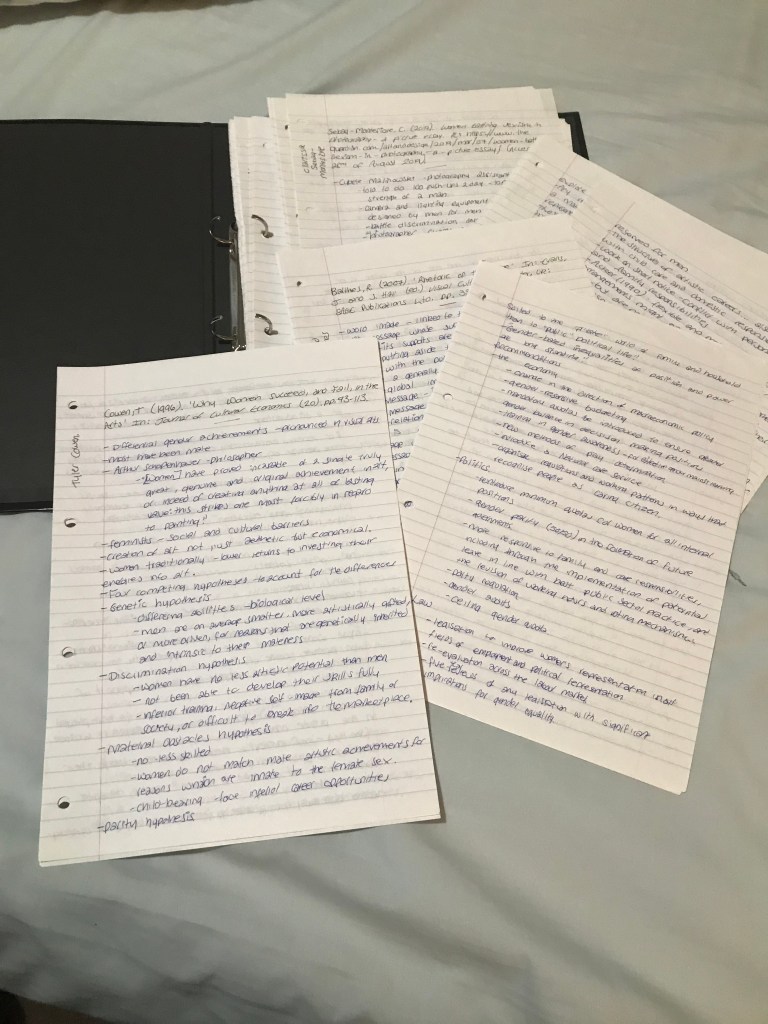
I have looked at a variety of sources, including books, journals, websites, artists work and personal experiences. I have organised this research into my research folder. It is taking shape, I do need to organise it a bit better. I have printed out the resources, then I have made notes and picked out quotes and important parts on a separate page. Here is a link to my research folder page, here I will upload images showing my research. At a later date, I will upload images of my research to view online.  


Here is my assignment:


Tutor Feedback

Here is a link to my tutor’s feedback for this assignment and also my comments and how I am responding to the feedback:

Tutor Feedback


Assignment Two – Literature Review

Brief

Write a 2,000 word literature review that identifies, summarises and critically discusses the most relevant texts that currently explore the subject area of your practice (i.e. the subject area you are exploring in ‘Body of Work’). Try to contrast differing points of view and indicate how you will expand your research into your extended written project.


Preparation

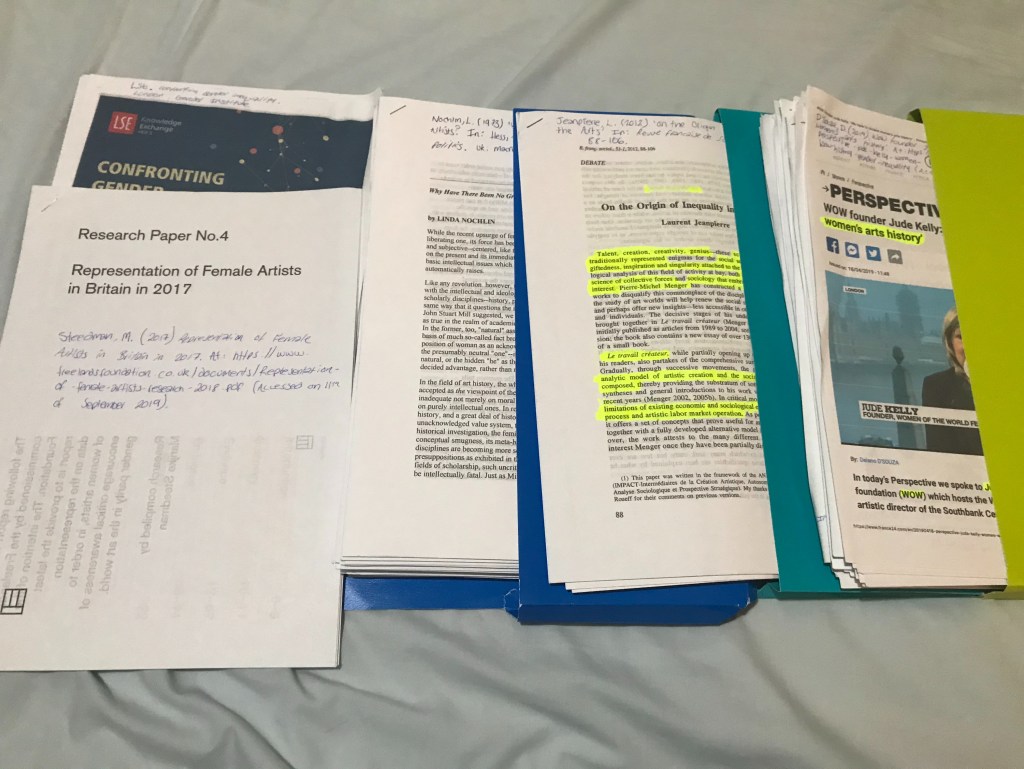
When I read the brief for this assignment, I was a bit apprehensive. I have written numerous essays but have never written a literature review. So this was a bit of an unknown for me. I started by researching into my topic, this helped me make a started and build my research folder. The more research, the stronger it will be. Here is my research folder taking shape:

I have printed off the journals, website, and books and made notes on each one, highlighting the important points made.

When I have compiled a good range of resources, I looked up about literature reviews.

I managed to get an idea of the format they should take. I went through my work and choose the key points and wrote them down in sections to organise. This helped me organise my literature review and helped to compose it.


Reflective Commentary

When I read the brief for this assignment, I was a bit apprehensive. I have written numerous essays but have never written a literature review. So this was a bit of an unknown for me. I started by researching into my topic, this helped me make a started and build my research folder. The more research, the stronger it will be. When I have compiled a good range of resources, I looked up about literature reviews. I managed to get an idea of the format they should take. I went through my work and choose the key points and wrote them down in sections to organise.

I decided to break my review down into sections, as I found this easier to organise and manage. I started writing the review and found it wasn’t as bad as I initially thought. I believe I still can improve it, my critical analysis definitely needs work. This is something I have been working on, and I can see progress. I hope I have done this review correctly, it was a bit difficult as it is something I have never done before, but I would like to think that I did manage ok.  

When looking at authenticity, I started mainly looking for books and journals. Which are mostly written by scholars. But there is limits to the amount of research you can find, so I looked further a field and found actual studies. Either commissioned by reputable organisations or by academics. I have looked online as a lot of information can be found there, especially interviews and articles. I have found numerous recent internet articles on the inequality in the arts. The majority are by academics and scholars, others are by journalists, and some by actual artists. I believe it is important, especially for this topic to get variety in research material. By looking at artists and interviews, you can get a sense of experience, and this is important, as facts can only get you so far. I also found readers comments quite useful, not as far as scholarly quality but it gives you an idea of how people think, how they talk about this subject. I looked at what the authors were saying. The authenticity of what they were saying was important. I find when researching the arts, the sources are more varied, the sources come form many places. Whereas when I did my previous degree, the research was mainly in books and journals. The arts, I have found has a vast platform of information to be utilized. 


Literature Review

Here is my literature review for assignment two:


Rework

I have reworked my assignment based on the feedback from my tutor. My tutor found that I had done the work, but it was evidenced in my research tab, I was advised to use this and discuss how it related to my work, which I have done.

I have looked into three books that look at gender equality and have summarised and analysed them.

Here is my reworked assignment:


Tutor Feedback

Here is a link to my tutor’s feedback for this assignment and also my comments and how I am responding to the feedback:

Tutor Feedback


Assessment Criteria

Demonstration of subject based on knowledge and understanding  

For my second assignment I had to review the most relevant texts in my subject area. I research the topic and found the relevant discussions and sources. I felt I had research the topic well for my first submission of the assignment. I wasn’t completely sure how to write a literature, so I research them. After my tutor feedback I saw where I went wrong. I had provide more of a summery of the topic rather than a review of the most relevant topics. However my tutor found that on my learning log I had actually reviewed the relevant books but I had failed to put that in my work. My rework of this assignment, I feel now meets the brief. Whilst I still have included a summery of the topic, my work now centres around the critical analysis of the main sources. 

Demonstration of research skills

I feel that I have done some in-depth research into my subject area. I have looked at various angles and theories and have brought them together in my work. I looked specifically at my topic but also have taken a wider look at theories and beliefs that may contribute in-directly. I looked for what I felt was the most relevant sources and have researched them and reviewed them. 

Demonstration of critical and evaluation skills

For my first submission, I felt that I did analysis the main theories but I failed to analysis certain sources, which my tutor recommended I do at my tutor review. I then choose the main relevant sources and presented their thrones and then critical analysed them and evaluated their thoughts and my own. 

Communication  

I felt I have communicated my ideas well and concisely. I had laid out my essay methodically. This means my work is clear and flows throughout, but also allows sections to be links and referred to. 

Assignment One – Visual Culture in Practice

Brief

Write a 1,000 – 1,500 word essay that relates your current work (the work that you made or are making in ‘Body of Work’) to an aspect of visual culture discussed in Part One. This assignment is diagnostic.


Preparation

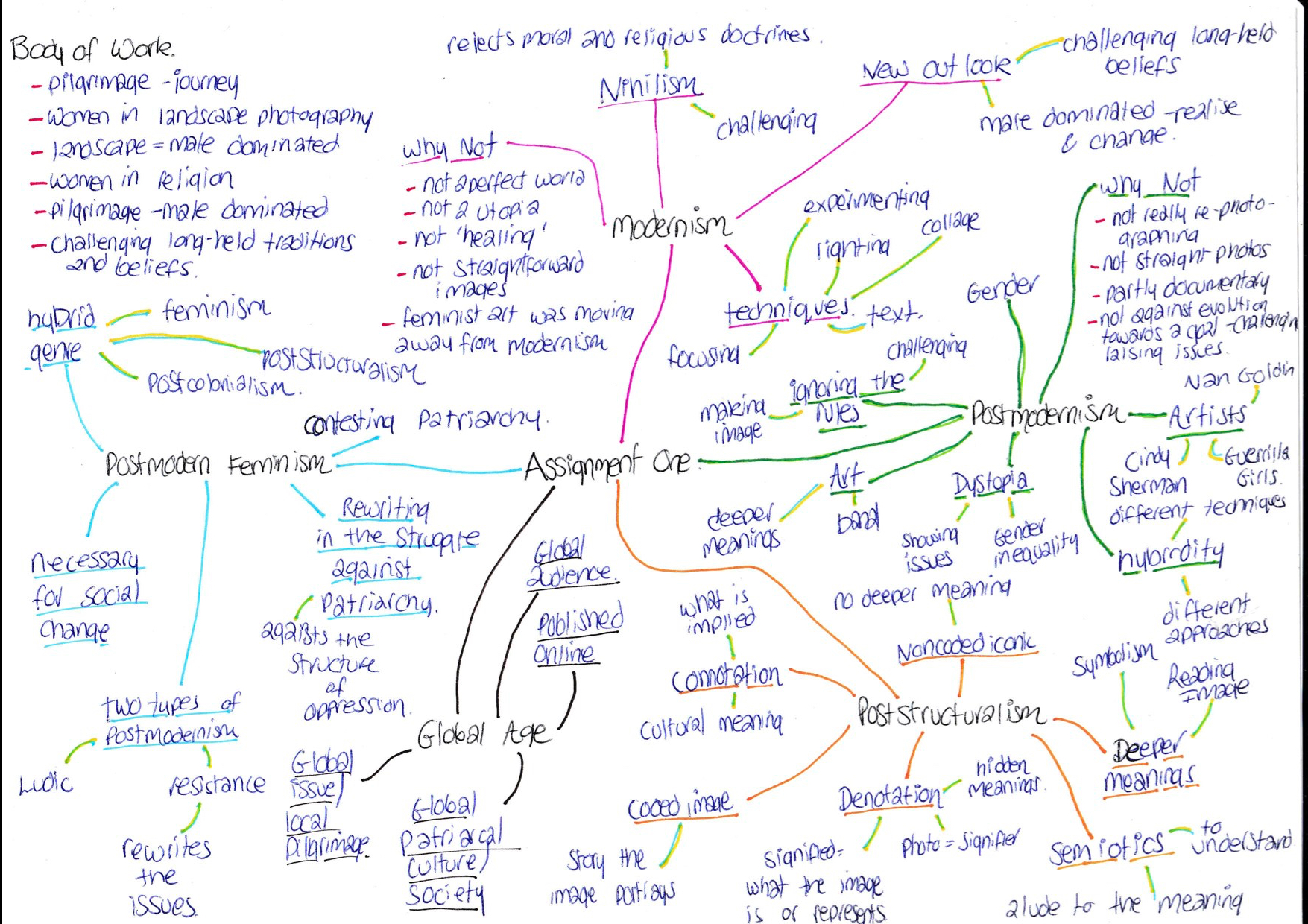
I started by reading through my course work and then researching each visual culture. I created a mind-map with reasons why my body of work fits into each category. I then looked at my research and felt that my work fitted into postmodernism better than any of the others. 

Here is my mind-map. 

Here is a link to my research. 

Assignment Research


Research

You can find my research under the drop down menu for this assignment or by clicking the following link:

Assignment Research


Assignment Reflection

You can find my assignment reflection under the drop down menu or by clicking the following link:

Reflection


Assignment One

Here is my assignment:


Tutor Feedback

Here is a link to my tutor’s feedback for this assignment and also my comments and how I am responding to the feedback:

Tutor Feedback


Assessment Criteria

Demonstration of subject based on knowledge and understanding

I have decided on my topic for my body of work. I read through the course work and decided to research each visual culture, so that way I could see which my work fits into. I made a mind map to keep my ideas together and so I could see the links. In my essay I explained why I felt my work fit into each category and even put forward an idea that my work would fit better into the postmodern feminism category. 

Demonstration of research skills

I researched each visual culture in order to understand them. This allowed me to see in which my work would fit into. I feel my research is evident. 

Demonstration of critical and evaluation skills

In my essay I gave reason to why my work would fit into each visual culture but I also gave my reason as to why I felt that it didn’t fit completely in. I was critical of where my work would ultimately lie. I went a step further and put forward another visual culture which I felt fitted my work better, which is postmodern feminism. It is a sub-category of postmodernism but I felt I couldn’t complete this assignment without bringing it into play. 

Communication  

I felt I communicated my idea plainly and in a methodological way. I spilt my work up into section so I could discuss each part before moving on. I believe I wrote my ideas out clearly and concisely.