Kara Walker is a collage artist who investigates issues surrounding gender, sexuality and race. She is known for her silhouettes on a white background. Her techniques reminds me of shadow puppets in a way. This could be seen as womens’ art, which also draws attention to the gender issues.
Martha Rosler is another artist who I have come across in my research. Her work takes many forms including performance, video, text, instillations and photomontages. The majority of her work in made from the perspective of a woman. Her feminist art looks to challenge the representation and expectations of women. In her works entitled Cold Meat I, Cold Meat II, Damp Meat (see fig. 1) and Hot Meat (see fig. 2).
(Fig. 1. Damp Meat)
(Fig. 2. Hot Meat)
Rosler combines images of naked women with domestic appliances. These works show how the female body is commodified, she compares it to food. “I was always interested in addressing people, primarily women but not only women, with the idea that you recognise me for other human beings” (Rosler Quoted in Murg). She uses images of women in magazines from the 1960s and the 1970s. She believes the tradition views of women still have a startling hold on women today. One image that stuck out was Cleaning the Drapes (see fig. 3), it shows a women vacuuming the curtains, whilst the spilt reveals a scene of soldiers. This contrasts the domestic view of women with the way the media showed people images of the Vietnam war, these images came to people through televisions which were relatively new.
Paula do Prado uses various techniques and materials including painting, textiles and photography. She addresses several issues in her work including identity, stereotypes, and race. Her work contains references to her culture as well as her experience of living in Australia. She is originally from Uruguay and often combines her heritage and language with her art. Her works often contains Spanish phases and sayings, this is an advantage in her art as “this tension between exclusion and inclusion is important” (Prado quoted in Madeleine). “Art provides a vehicle for me to explore, scrutinise, decipher and tease out these interconnections between culture, race and identity…dealing with some of these issues is hard…I’m not an activist by any means…It”s more about seeing things differently” (Prado quoted in Madeleine). Her work on gender is helpful for my work, I am looking at gender, and much of her work does too, she sees gender “like race, as another category that is socially constructed, that I don’t think anyone truly fits into neatly” (Prado Quoted in Madeleine).
In Some Living American Women Artists (see fig. 1), Mary Beth Edelson replaced the heads of the figures in the Last Supper with female artists. The image of the Last Supper is still recognisable, the structure of the image is unchanged. Edelson has only added images of the heads of female artists in place of Christ and his disciples. When I first looked at this image, to me it appears to be drawing a comparison between the patriarchy in the art world with the patriarchy in religion. Edelson shows women in the roles of men, it represents how women struggle against tradition, expectation and inequality in their work and lives. It shows just a small amount of female artists there are, but they are often overlooked and dismissed. This is similar to what I am trying to do. I am attempting to look at the inequality in the art world by using a male dominated pilgrimage route. This artwork is influential to my work, as it has the same principles and aim behind it. Edelson also uses collage techniques to accomplish this, which is what I want to do. It also links religion and art together. This work is quite symbolic, Linda Aleci believes it “honors the ecumenical ideals of communion and community” (Aleci quoted in Greifen). Edelson compares the historical systematic omission of women in art and in aspects of religion. Edelson explains why she choose to challenge religion, as “the most negative aspect of organized religion, for me was the positioning of power and authority in the hands of a male hierarchy that intentionally excluded women from access to these positions…[The work] gave me a double pleasure of presenting the names and faces of the many women artists who were seldom seen in the art world of 1972 as ‘the grand subject’—while spoofing male exclusivity in the patriarchy” (Edelson quoted in Dang).
(Fig. 1. Some Living American Women Artists (1972))
Jess Kohls series Friends of the Dead, features portraits taken in a cemetery. The portraits feature visitors to the sites. It shows the connection between the living and the dead. Whilst I am not using portraits in my body of work, Kohls work is valuable to me as I can see how she has taken her images in the cemetery. Her images are quite dark, they are also in monochrome. Which, similar to Kikkas, gives him images a peaceful yet haunting feel.
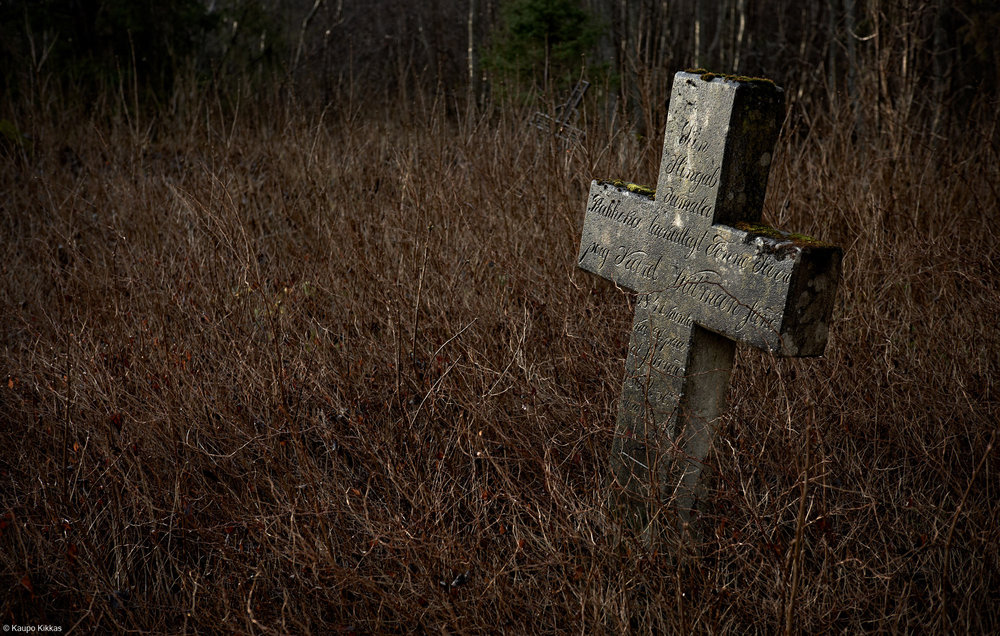
In his project, La Bella Morte, Kaupo Kikkas explored cemeteries around the world. His images show how various cultures deal with their death, it also shows a social and cultural aspect as we can see how they graves and cemeteries are kept. His images are quite peaceful, he himself stated that he has built his project in a quite area of landscape photography. This is also what I like about his images, the fact that he see them as landscapes, it is just different from what we are use to seeing. “You may view this as a documentation of graveyards, a death cult, or simply landscape photography” (Kikkas). I find his images fascinating as it looks at a part of life which people tend to avoid like the plague, but it is a fact of life, death is inevitable. It is visually interesting to see how various cultures deal with their dead, where they end up, and how it is maintained. Some of his images are quite haunting. They are moving, as these were people and now they have been laid to rest. I get a peaceful feeling from his images, but at the same time quite an isolating one too. The images he has taken vary in landscape, but also the graves vary, some have one, others may dozens. This image (see fig. 1), show one lone grave.
(Fig. 1. Untitled #19)
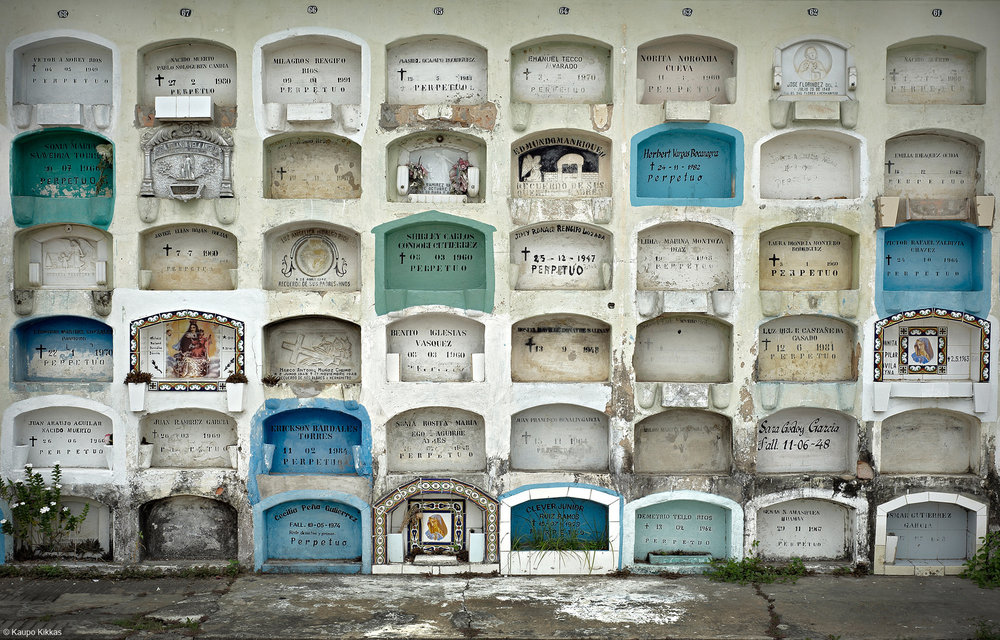
The cross is nestled among the long wild grass, obviously not a maintained or regularly visited site. The image has a darkness to it. Kikkas has taken the image from ground level, it almost feel we are on the same level as the dead person, it gives the reader a closer connection. The next image (see fig. 2) shows dozens of graves stacked up.
(Fig. 2. Untitled #3)
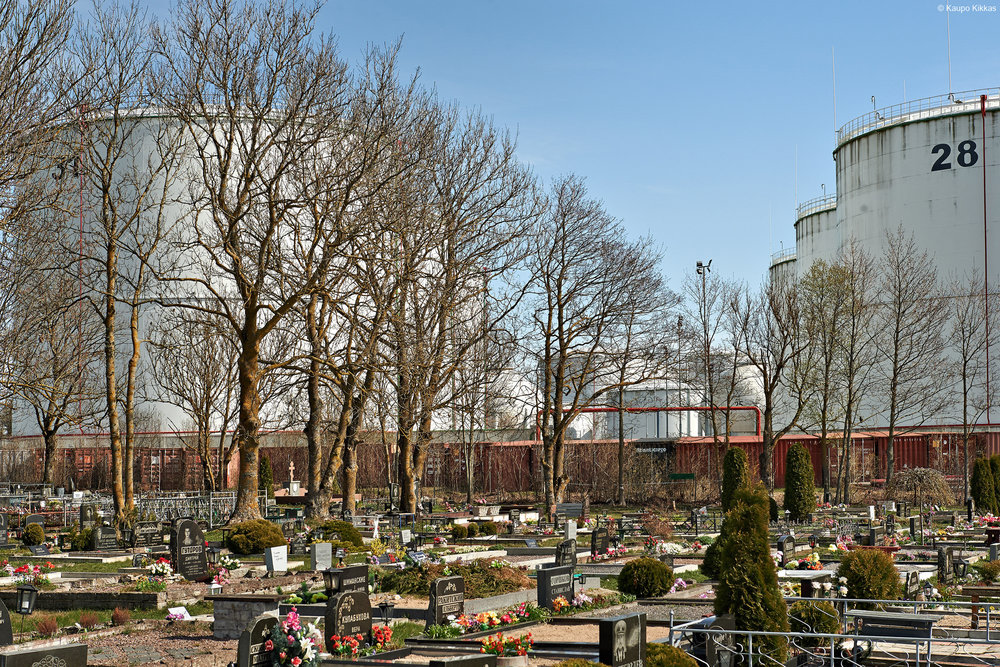
They are quite colourful and visually and aesthetically beautiful in my opinion. You can see some graves with flowers, others look very old where people probably haven’t visited. The difference is staggering. I like this image as it shows that despite each grave has a name and a date, they are just one of many. It feels to me that everyone ends up on the same level, which is true really, as we all end up dead. Who we are living, doesn’t change that fact. This last image (see fig. 3), shows a startling comparison between the living and the dead.
(Fig. 3. Untitled #13)
In the foreground, we see a very well kept cemetery. Several headstones look new and clean, there are flowers, the paths are maintained and neat. Yet separated by only a fence is some sort of industrial site, where life goes on. I would say the cemetery was probably there first, and the industrial site was built after, could this be seen as a bit disrespectful being right next to a cemetery or not? Or the fact that life continues for those outside the cemetery grounds. I feel his images have influenced my direction, as this is a similar scene I am photographing. It has been helpful, to see how he has approached this subject and how he has maintained the respect. His images are interesting, I do like his low position for figure one, I believe this is quite effective, something I am using in my work.
Kikkas also created another series which has been of interest. It is called Ansel. Kikkas was inspired by Ansel Adams, his images are quiet similar. They are perfectly composed, and infocus, they are also in monochrome, with an impressive grey tonal range. His images are striking. I may try my images in black and white, I think this might be a good move for my project. Monochrome gives the images a timeless feel, coupled with the church landscape I think my images will become quite haunting an mysterious.
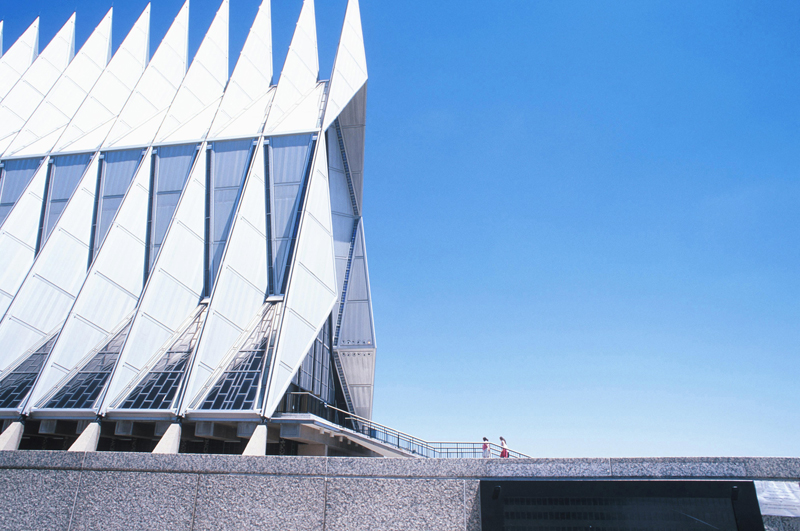
Nina Berman has explored the concept of newly constructed churches in America in her series entitled, Megachurches. These particular churches are massive and have a large congregation. In her accompanying text, Berman states that “every two days, a new megachurch emerges in America” (Berman, 2005). This shows the scale and popularity of these churches. Her images were taken in Florida, Ohio, Kentucky, Colorado and Arkansas between 2004 and 2005. A few of her images show a small section of the congregation but the images that stand out to me are the ones that show the buildings. The images that show the building also feature people, but only two. This image of the United States Airforce Chapel in Colorado (see fig. 1) is very eye-catching.
(Fig. 1. United States Airforce Chapel, Colorado (2004-2005))
Berman took the image from just of the side of the church. It shows the straight lines and geometric shaping of the building which rises up to the sky. She has taken the image from a lower point, this gives the building an impressive profile, it fills the sky. The sky is absolutely clear and blue, this teamed with the glass and white building gives the image a very light feel. It looks almost ‘pure’.
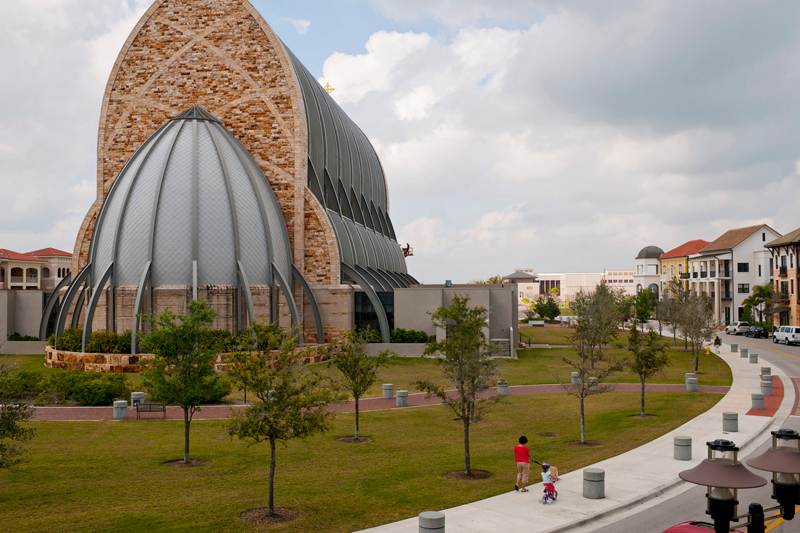
This next image is of the Ave Maria Oratory in Florida (see fig. 2). This particular church cost in the region of $24 million. The grandeur of the building is evident, you can see this is a building of importance. It is placed in the center of a residential area, and as such the tall structure raises high above it all. It looks at home there, the curves of the building seem to follow the survey of the road. The grey walls match the grey skies. The only problem is the Berman have cut the top of the building off in her image, this may be intentional of course. To me it may symbolise how the church is reaching up into the heavens to something we cannot see.
(Fig. 2. The Ave Maria Oratory (2004-2005))
Berman has given me a chance to see how artists have tackled the challenge of photographing churches. It is a documentary style approach, a bit different form my approach but I feel her images have been of use to me. I like the positioning she has used, she has taken a low angle, which were I would like my images to go.
Figure 1. Berman, N. (2004-2005). United States Airforce Chapel, Colorado. [Photography – Online]. At: https://www.thecaprareview.com/?page_id=1417 (Accessed on 10th of September 2019).
I want to talk about the male gaze in my extended project. I believe that the male gaze will influence the images that male photographers will take. I believe this is because men and women see the world differently. Many things can effect someones gaze, for example any Experience can influence us. But I think gender does also have an effect. To investigate this I will look at Ansel Adam’s work, as he is a well-known landscape photographer. I will compare his images with a female photographer that was around at the same time, Dorothea Lange. My first thought is that Adams approach to his landscapes is quite predatory, his images are harsh and dominating. For the following images, they show a different subject. One thing to note is that Lange’s images were effected by her working for the FSA. But they still choose which images to take.
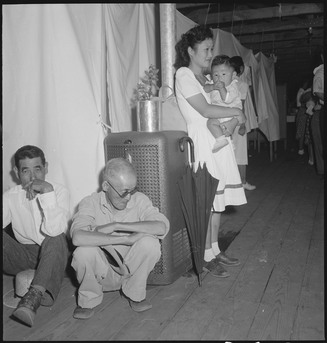
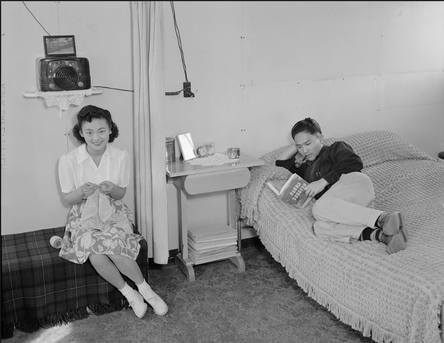
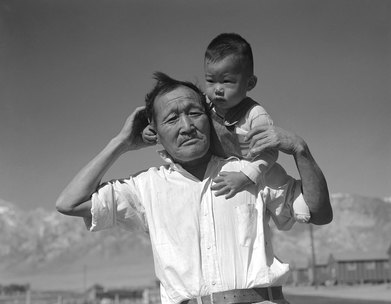
I have looked at female photographers who were around at the same time as Adams, who also used similar approaches. One is Dorothea Lange. Both artists photographed the Manzanar War Relocation Center during the second world war. The center was a concentration encampment in California, which held over a hundred thousand Japanese Americans. There is a clear different in their approaches and what they are trying to show. Lange’s images show the difficulties the people faced. Her images showed emotion, they showed sadness and sorrow. For example here is one of her images (see fig. 1), showing the difficult living conditions. Each ‘room’ is separate by a cloth sheet and there are several to a room. There appear to be a lack of seating and anything of comfort. In contrast, here is Adams image (see fig. 2) of the accommodation. It shows two people sharing in comfort. There is a bed, setting, the people look content, one is reading, the other is crafting. This is very different to oppressive feel of Lange’s image (Palumbo, Unknown Author).
(Fig. 1. Lange. A typical interior scene in one of the barrack apartments at this center. Note the cloth partition which lends a small amount of privacy)
(Fig. 2. Adams. Mr. & Mrs. Dennis Shimizu)
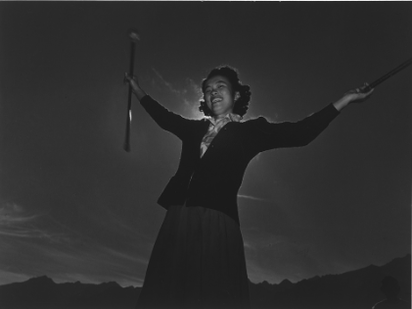
In another image (see fig. 3) Adams shows a young women practising with a baton, she is posing and appears very happy. Yet in Lange’s image (see fig. 4) there is a boy and his grandfather, both looking sad and upset. They are not happy.
(Fig. 3. Adams. Baton practice. Florence Kuwata)
(Fig. 4. Lange. Manzanar Relocation Center, Manzanar. California. Grandfather and Grandson of Japanese Ancestry at This War Relocation Authority Center)
Adams images show hope and comfort. Almost as if they people who owned the camp had commissioned to images, to make them look better. But Lange’s show the real desperation and sorrow. There is a stark contrast in these images, one from a female perspectives and one from a male perspective. This could be an example of the differences between a male and female gaze. It is not a matter of men representing women in a sexual way, this is not the case here. But it shows the differences in approach and though-process. It is a matter of what they choose to show, their objectives. I think the difference between a male and female gaze is simply how we see things. Because there is a difference. Adams images show the untouched landscape of America. His images are technically precise and perfectly focused. They show how beautiful the area is, when people haven’t been there, his images show emotion. Adams shows the beauty. Whereas many of Lange’s landscapes show have an agenda. They document social and political issues, they weren’t about showing beautiful landscapes (Palumbo, Unknown Author).
Fig. 1. Lange, D. “A typical interior scene in one of the barrack apartments at this center. Note the cloth partition which lends a small amount of privacy” [Photograph – Online]. Available at: http://langeandadamstakingastand.weebly.com/comparison.html# (Accessed on 2nd of September 2019).
Fig. 4. Lange, D. Manzanar Relocation Center, Manzanar. California. Grandfather and Grandson of Japanese Ancestry at This War Relocation Authority Center. [Photograph – Online]. Available at: http://langeandadamstakingastand.weebly.com/comparison.html# (Accessed on 2nd of September 2019).
The sites on this pilgrimage hold a deep significance. Pilgrims undertake this to feel closer to their faith, to feel closer to where their faith was established, and to follow the path where saints once walked. This in turn gives the pilgrims spiritual guidance and a chance to enhance their faith. Pope Callixtus legitimised the pilgrimage to St. David’s Cathedral in the 12th century.
The pilgrimage follows ancient routes that links the churches that were the bases for the establishment of Christianity in Wales. The arrival of the first Christian pilgrims can be dated back around 1,500 years ago. These pilgrims arrived by sea from Jerusalem and Rome. They made this journey to achieve spiritual accomplishment. They reached Pembrokeshire, which was a land of Pagans, and they stayed to bring Christianity to this land. We know them as saints today, but men like David, Justinian, Colman, Brynach, Gwyndaf, Telio and Patrick, were all responsible for establishing communities and churches with the goal of establishing and converting the area. These saints are known for their devotion to the dissemination of Christianity. This period of time was known as the age of the saints. These initial journeys marked a route that attracted other holy men and missionaries as pilgrims. They could either arrive by sea or by land and trace the path that established their faith. One of the most recognisable and most influential of the establishers in Wales was Saint David. St. David holds a special place in the history of but also in modern day Wales. He is a symbol of the nation, and holds an identity the people of Wales can relate to. This is important to the history of Wales and to its people.
This pilgrimage was established by the actions of men. They become saints, and places in Pembrokeshire are still dedicated to them. Their actions still resound across the landscape. The early pilgrims were missionaries and holy men. They follow their forbearers to feel closer to their faith and in turn to be closer to their God. Generations of holy men continued to come on this pilgrimage. This pilgrimage was created by men and become one for men, because it became born of an established tradition. This is similar to how gender inequality has been disseminated from an established thought and traditions.
Here is a link to the research on Pilgrimages that I have done for my Body of Work:


 Georgina's Contextual Studies