Hamish Fulton

Hamish Fulton

Hamish Fulton is a British artist known for his photographs taken whilst walking. It was after Fulton walked from John O’Groats to Lands End, he decided that he would make “only art resulting from the experience of individual walks” (Fulton quoted in Eyestorm). His work looks at the affinity between art and the landscape. To Fulton, each walk is different and each has an atmosphere that is unique. He photographs his walks, and as such is the one to physically experience it. But the viewer is allow a glimpse at his experience through his images and accompanying text. His methods allow him freedom whilst also addressing issues surrounding the environment. He believes people have become distanced between our natural environment. The use of text is his work is interesting. The text is usually sizeable and placed directly over the landscape images. His image Wind through the Pines is an example of this. The image (see fig. 1) is of a forest scene with the following words layered over the image:

“Wind through the pines

Clouds of breath and steam in the cold candle lit air

Seven days walking and seven nights camping in a wood Cairngorms Scotland March 1985

Song of the Chaffinch

Changing tune of the stream

Walking fo seven days in a wood Cairngorms Scotland April 1991”

(Fig. 1. Wind through the Pines (1985, 1991))

The text and image give off a nostalgic, reminiscent and romantic feeling. The text fills the image but in my opinion doesn’t distract from the image, which is still visible. The text enhances the image. 

The next image (see fig. 2) is of a stone stair scene in Japan, with the text:

“The life of scattered stones

Seven one day walks in the rain Nikko Japan April 1990”

(Fig. 2. The Life of Scattered Stones (1990))

I like this image. I find it very calming and peaceful even though the stones are scattered around and hit by the weather, they are still there, as strong and solid as ever. 

The method Fulton uses is a good example of text in landscape images, which is what my images are. I am going to take notes from his methods, as I like the effect his use of text has, and could help my body of work.  


Figures

Fig. 1. Fulton, H (1985, 1991) Wind through the Pines. [Photograph – Online] At: https://www.tate.org.uk/art/artworks/Fulton-wind-through-the-pines-p7762/(Accessed on 7th of November 2019). 

Fig. 2. Fulton, H (1990) The life of scattered Stones. [Photograph – Online]. At: https://www.eyestorm.com/Pages/Product.aspx/Hamish_Fulton/The_Life_of_Scattered_Stones._Seven_One_Day_Walks_in_the_Rain_Nikko_Japan_(1990)__2000/4579423 (Accessed on 7th of November 2019).


Bibliography

Eyestorm. Hamish Fulton. At: https://www.eyestorm.com/pages/browse.aspx/artist/hamish_fulton/10/ (Accessed on 7th of November 2019). 

Lake-Edwards, C (2018) Hamish Fulton ‘Leave only Footsteps, take only photographs’. At: https://www.eyestorm.com/Pages/Magazine.aspx/HAMISH_FULTON___|____LEAVE_ONLY_FOOTSTEPS__TAKE_ONLY_PHOTOGRAPHS_/985 (Accessed on 7th of November 2019).  

National Galleries Scotland. Hamish Fulton. At: https://www.nationalgalleries.org/art-and-artists/artists/Hamlisch-Fulton (Accessed on 7th of November 2019). 

Barbara Kruger

Barbara Kruger

Barbara Kruger is an American conceptual artist, known for her bold graphic images. Kruger was a photographer for two years, but she decided to move towards utilising found images in her work. The images are usually black and white. She gets most of her images form the media, she then edits them and places bold text over the image. The text is usually red and white which creates a striking contrast against the monochrome image. It draws the viewers attention and make us think about the issues she is exploring. The issues Kruger looks at range from feminism, to politics, to consumerism, religion and power. Her images are very recognisable and address these issues with purposely selected images and text. 

In 1980, Kruger released an untitled image, but due to the text, it is known as ‘Perfect’ (see fig. 1). It shows a woman with her clasped as if praying. We only see her torso, she is a plain jumper of cardigan. The woman gives the impression of innocence, faith and obedience. Kruger calls on the idea of the virgin Mary. The image represents in sense the perfect women, a dutiful passive embodiment of femininity. 

(Fig. 1. Perfect (1980))

Another image Kruger produced, is probably one of her most notable pieces. The untitled work (see fig. 2), ‘Your Body is a Battleground’ brings to light the anti-abortion laws. The images was made specially for the Woman’s March on Washington in 1989. Kruger showed her support for the freedom of choice for women. The image features a portrait of a woman, which is spilt vertical, half in positive and half in negative. This is a powerful image, which has remained relevant throughout the years. To me it can be seen as much more than support for reproductive choices, it can refer to other areas where women are restricted, judged and oppressed. 

(Fig. 2. Your Body is a Battleground (1989))

Krugers use of text is bold. It stands out, almost overtakes the image and alludes to the deeper meanings. The use of red and white text creates a striking contrast to the black and white image. Her wordings are often very simple but do echo a issue or problem. Her images are very successful and I will be taking note when looking at using text in my body of work. 


Figures 

Fig. 1. Kruger, B (1980) Untitled (Perfect) [Photograph – Online] At: https://www.artic.edu/artworks/159464/untitled-perfect (Accessed on 7th of November 2019).   

Fig. 2. Kruger, B (1989) Untitled (Your Body is a Battleground) [Photograph – Online]At: https://www.thebroad.org/art/barbara-kruger/untitled-your-body-battleground(Accessed on 7th of November 2019).  


Bibliography

Art History Archive. Barbara Kruger. At: www.arthistoryarchive.com/arthistory/feminist/Barbara-Kruger.html (Accessed on 7th of November 2019). 

Guggenheim. Barbara Kruger. At: https://www.guggenheim.org/artwork/artist/barbara-kruger (Accessed on 7th of November 2019). 
Kruger, B (1989) Untitled (Your Body is a Battleground). At: https://www.thebroad.org/art/barbara-kruger/untitled-your–body-battleground(Accessed on 7th of November 2019).  
Mitchell, W. J. T. & B. Kruger. (1991) ‘An Interview with Barbara Kruger’ Critical Inquiry, Vol. 17, No. 2, pp. 434-448.  

Kara Walker

Kara Walker

Kara Walker is a collage artist who investigates issues surrounding gender, sexuality and race. She is known for her silhouettes on a white background. Her techniques reminds me of shadow puppets in a way. This could be seen as womens’ art, which also draws attention to the gender issues. 


Bibliography

Walker Art. Kara Walker. At: https://walkerart.org/collections/artists/kara-walker(Accessed on 18th of November 2019). 

Walker, K. Biography. At: wwwkarawalkerstrudio.com/biography/ (Accessed on 18th of November 2019).  

Woodward, D (2016) Three Radical Female Collage Artists You Need to Know. At: https://www.anothermag.com/art-photography/8849/three-radical-female-collage-artists-you-need-to-know (Accessed on 18th of November 2019).  

Martha Rosler

Martha Rosler  

Martha Rosler is another artist who I have come across in my research. Her work takes many forms including performance, video, text, instillations and photomontages. The majority of her work in made from the perspective of a woman. Her feminist art looks to challenge the representation and expectations of women. In her works entitled Cold Meat I, Cold Meat II, Damp Meat (see fig. 1) and Hot Meat (see fig. 2). 

(Fig. 1. Damp Meat)
(Fig. 2. Hot Meat)

Rosler combines images of naked women with domestic appliances. These works show how the female body is commodified, she compares it to food. “I was always interested in addressing people, primarily women but not only women, with the idea that you recognise me for other human beings” (Rosler Quoted in Murg). She uses images of women in magazines from the 1960s and the 1970s. She believes the tradition views of women still have a startling hold on women today. One image that stuck out was Cleaning the Drapes (see fig. 3)it shows a women vacuuming the curtains, whilst the spilt reveals a scene of soldiers. This contrasts the domestic view of women with the way the media showed people images of the Vietnam war, these images came to people through televisions which were relatively new. 

(Fig. 3. Cleaning the Drapes)

Figures

Fig. 1. Rosler, M. Damp Meat [Photograph – Online] At: www.martharosler.net/photo.body/damp-meat.html/ (Accessed on 18th of November 2019).  

Fig. 2. Rosler, M. Hot Meat [Photograph – Online] At: www.martharosler.net/photo/body/hot_meat.html(Accessed on 18th of November 2019).  

Fig. 3. Rosler, M. Cleaning the Drapes [Photography – Online] At: https://www.moma.org/collection/works/150123?artist_id=6832&locate=en&page=1&sov_referrer=artist (Accessed on 18th of November 2019).  


Bibliography

Murg, S. Interview with Martha Rosler, the Artist who speaks softly but carries a big shtick. At: https://pinupmagazine.org/articles/interview-with-brooklyn-artist-martha-rosler-jewish-museum-nyc-survey-show (Accessed on 18th of November 2019).

Woodward, D (2016) Three Radical Female Collage Artists You Need to Know. At: https://www.anothermag.com/art-photography/8849/three-radical-female-collage-artists-you-need-to-know(Accessed on 18th of November 2019).  

Paula do Prado

Paula do Prado  

Paula do Prado uses various techniques and materials including painting, textiles and photography. She addresses several issues in her work including identity, stereotypes, and race. Her work contains references to her culture as well as her experience of living in Australia. She is originally from Uruguay and often combines her heritage and language with her art. Her works often contains Spanish phases and sayings, this is an advantage in her art as “this tension between exclusion and inclusion is important” (Prado quoted in Madeleine). “Art provides a vehicle for me to explore, scrutinise, decipher and tease out these interconnections between culture, race and identity…dealing with some of these issues is hard…I’m not an activist by any means…It”s more about seeing things differently” (Prado quoted in Madeleine). Her work on gender is helpful for my work, I am looking at gender, and much of her work does too, she sees gender “like race, as another category that is socially constructed, that I don’t think anyone truly fits into neatly” (Prado Quoted in Madeleine).  


Bibliography  

Madeleine, A. Paulo do Prado. At: https://wwwartistprofile.com.au/paula-prado/(Accessed on 18th of November 2019).  

Mary Beth Edelson

Mary Beth Edelson

In Some Living American Women Artists (see fig. 1)Mary Beth Edelson replaced the heads of the figures in the Last Supper with female artists. The image of the Last Supper is still recognisable, the structure of the image is unchanged. Edelson has only added images of the heads of female artists in place of Christ and his disciples. When I first looked at this image, to me it appears to be drawing a comparison between the patriarchy in the art world with the patriarchy in religion. Edelson shows women in the roles of men, it represents how women struggle against tradition, expectation and inequality in their work and lives. It shows just a small amount of female artists there are, but they are often overlooked and dismissed. This is similar to what I am trying to do. I am attempting to look at the inequality in the art world by using a male dominated pilgrimage route. This artwork is influential to my work, as it has the same principles and aim behind it. Edelson also uses collage techniques to accomplish this, which is what I want to do. It also links religion and art together. This work is quite symbolic, Linda Aleci believes it “honors the ecumenical ideals of communion and community” (Aleci quoted in Greifen). Edelson compares the historical systematic omission of women in art and in aspects of religion. Edelson explains why she choose to challenge religion, as “the most negative aspect of organized religion, for me was the positioning of power and authority in the hands of a male hierarchy that intentionally excluded women from access to these positions…[The work] gave me a double pleasure of presenting the names and faces of the many women artists who were seldom seen in the art world of 1972 as ‘the grand subject’—while spoofing male exclusivity in the patriarchy” (Edelson quoted in Dang). 

(Fig. 1. Some Living American Women Artists (1972))

Figures

Fig. 1. Edelson, M. B (1972) Some Living American Women Artists [Photograph – Online] At: https://www.moma.org/collection/works/117141 (Accessed on 18th of November 2019).  


Bibliography

Dang, F (2016) The Art of Storytelling. At: samblog.seattleartmuseum.org/tag/some-living-american-women-artists-last-supper/ (Accessed on 18th of November 2019). 

Griefen, K. Considering Mary Beth Edelson’s Some Living American Women Artists. At: https://brooklynrail.org/2019/03/criticspage/Considering-Mary-Beth-Edelsons-Some-Living-American-Women-Artists (Accessed on 18th of November 2019).  

Preparation

Preparation

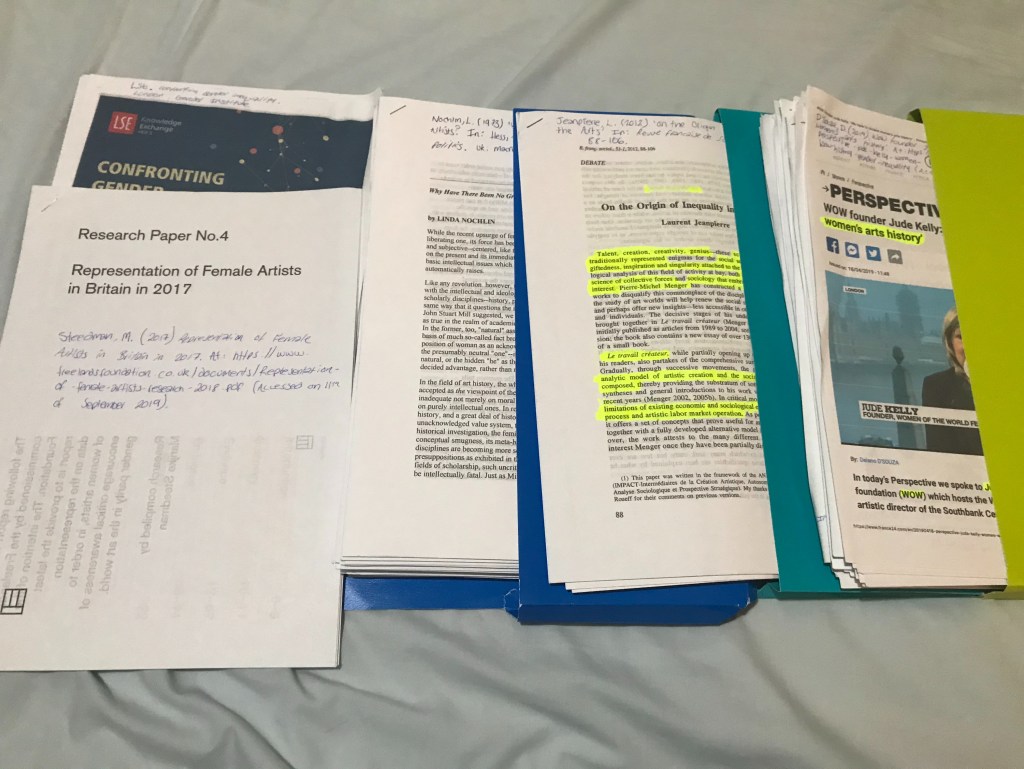
When I read the brief for this assignment, I was a bit apprehensive. I have written numerous essays but have never written a literature review. So this was a bit of an unknown for me. I started by researching into my topic, this helped me make a started and build my research folder. The more research, the stronger it will be. Here is my research folder taking shape:

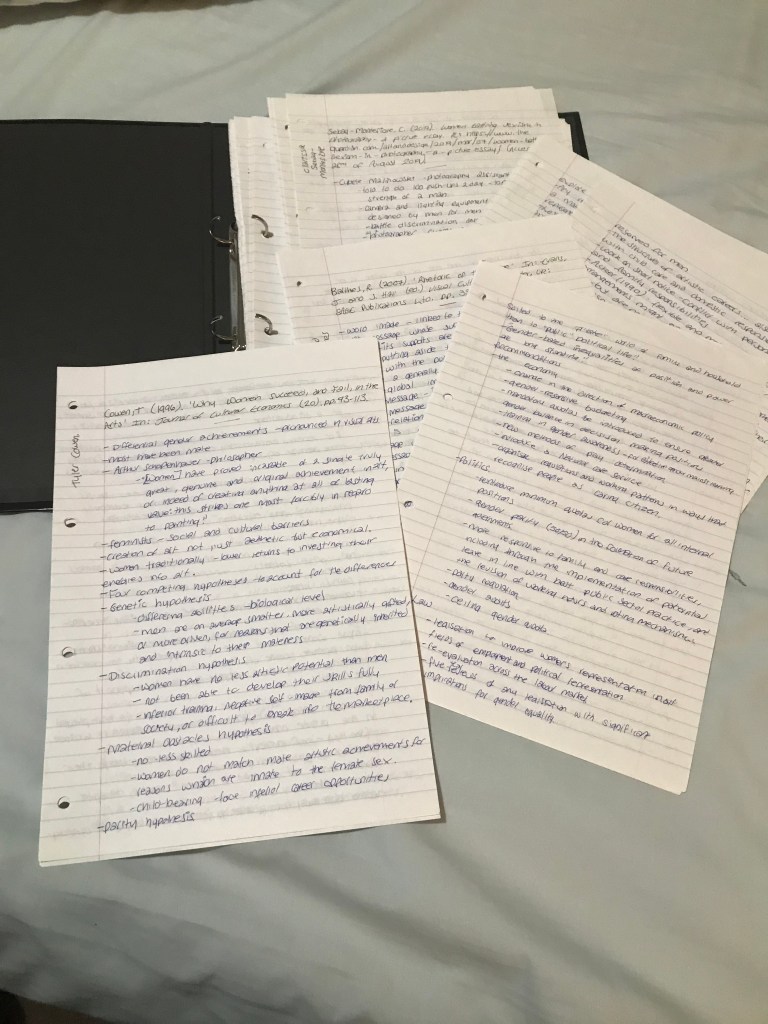
I have printed off the journals, website, and books and made notes on each one, highlighting the important points made.

When I have compiled a good range of resources, I looked up about literature reviews.

I managed to get an idea of the format they should take. I went through my work and choose the key points and wrote them down in sections to organise. This helped me organise my literature review and helped to compose it.


Reflective Commentary

Reflective Commentary

When I read the brief for this assignment, I was a bit apprehensive. I have written numerous essays but have never written a literature review. So this was a bit of an unknown for me. I started by researching into my topic, this helped me make a started and build my research folder. The more research, the stronger it will be. When I have compiled a good range of resources, I looked up about literature reviews. I managed to get an idea of the format they should take. I went through my work and choose the key points and wrote them down in sections to organise.

I decided to break my review down into sections, as I found this easier to organise and manage. I started writing the review and found it wasn’t as bad as I initially thought. I believe I still can improve it, my critical analysis definitely needs work. This is something I have been working on, and I can see progress. I hope I have done this review correctly, it was a bit difficult as it is something I have never done before, but I would like to think that I did manage ok.  

When looking at authenticity, I started mainly looking for books and journals. Which are mostly written by scholars. But there is limits to the amount of research you can find, so I looked further a field and found actual studies. Either commissioned by reputable organisations or by academics. I have looked online as a lot of information can be found there, especially interviews and articles. I have found numerous recent internet articles on the inequality in the arts. The majority are by academics and scholars, others are by journalists, and some by actual artists. I believe it is important, especially for this topic to get variety in research material. By looking at artists and interviews, you can get a sense of experience, and this is important, as facts can only get you so far. I also found readers comments quite useful, not as far as scholarly quality but it gives you an idea of how people think, how they talk about this subject. I looked at what the authors were saying. The authenticity of what they were saying was important. I find when researching the arts, the sources are more varied, the sources come form many places. Whereas when I did my previous degree, the research was mainly in books and journals. The arts, I have found has a vast platform of information to be utilized. 


Warner, M (1976) Alone of All Her Sex: The Myth and the Cult of the Virgin Mary. Oxford: Oxford University Press.

Warner, M (1976) Alone of All Her Sex: The Myth and the Cult of the Virgin Mary. Oxford: Oxford University Press. 


This book was recommended by my tutor. I managed to get a copy and began reading through it. It is well paced and easy to read. Warner gets her point across in a way that is easy to understand. The book is broken down into sections, firstly Warner looks at Mary as the Virgin, then as a Queen, as a bride, as a mother, and lastly as an intercessor. Warner talks about the Virgin Mary throughout history and how she has been attributed and moulded to the developing ideologies within the Catholic Church over time. She looks into how Mary is seen within the church and how her images has been strengthened over time. Warner looks at how Mary has been depicted though art, scripture and beliefs. A link has been proposed between how prominent Mary is to the culture of the time. For example, at times she is seen as passive whereas at another point in history she is seen as glorious. She alternates between a human figure to being venerated like a saint (Warner, 1976). 

Warner goes on to talk about how this view of the virgin Mary has effected women today. This is an important point that she has touched upon. Religion is powerful and overtime it can influence societies views. In this case, it has created a status for a female figure that no women can ever live up to. This has contributed to women being oppressed and the views about a women role. As well as contributing to the structure of society (Warner, 1976). 

“The Virgin Mary is no the innate archetype of female nature, the dream incarnate; she is the instrument of a dynamic argument from the Catholic Church about he structure of society, presented as a God-given code…in 1974 Pope Paul VI…attempted to represent her as the steely champion of the oppressed and a women of action and resolve. She should not be though of, he wrote, “as a mother exclusively concerned with her own divine Son, but rather as a women whose action helped to strengthen the apostolic community’s faith in Christ.” But the Vatican cannot simply strip away a veil and reveal Mary’s Metamorphosis into the New Women unless it dredges centuries of Prejudice. (Warner, pp. 344)” 

This relates to the inequality we have seen for centuries, these ideals and ideas have reinforced the ideal women which women cannot live up to. The role of a women has been solidified and thus in today’s world makes it very difficult for women to attain true equality. If the virgin Mary is the ideal view of a women, how can anyone live up to that. “Although Mary cannot be a model for the New Woman, a goddess is better than no goddess at all, for the sombre-suited masculine world of the Protestant religion is altogether too much like a gentlemen’s club to which the ladies are only admitted on special days” (Warner, pp. 345). 

Warner ends by stating, “the Virgin’s legend will endure in its splendour and lyricism, but it will be emptied of moral significance, and this lose its present real powers to heal and to harm” (Warner, pp. 345). I can see this book causing quite the stir among some Catholics. This type of book, where the author looks into a part of religion and critiques and analysis it, does evoke a strong reaction. I am not religious but can see why a Catholic might disagree with Warners findings. But for me having read it, I find it fascinating.

(Warner, 1976; Stewart, G).